U.S. stock futures fall after Wall St pullback as bond yields, oil surge
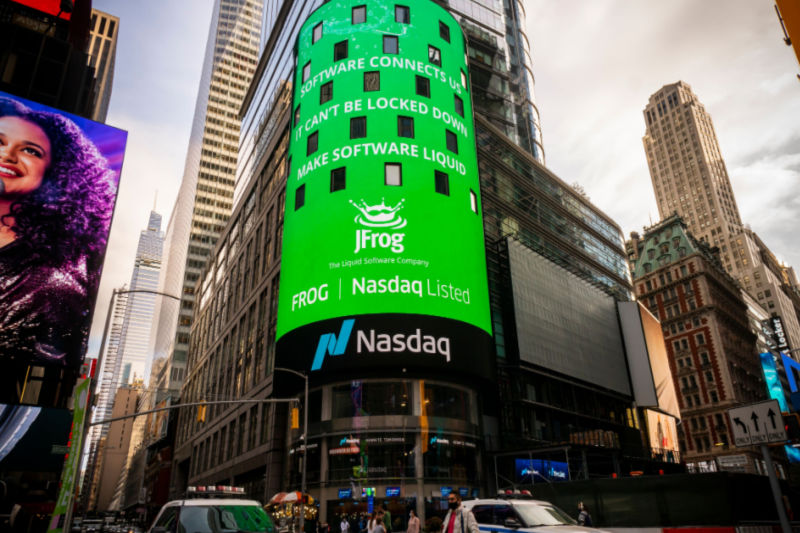
JFrog Ltd. (NASDAQ:FROG), a software company specializing in binary repository management and DevOps solutions, has emerged as a focal point for investors seeking exposure to artificial intelligence-driven software development trends. The company’s Artifactory product, which allows organizations to store, secure, and govern software binaries and packages, has positioned it at the intersection of several technology megatrends, including AI code generation, enterprise security, and cloud migration.
Currently trading at $73.43 with a market capitalization of $8.89 billion, the stock has delivered impressive returns of 72% over the past year. The company generated $563 million in revenue over the last twelve months with a remarkable gross profit margin of 77%, though InvestingPro analysis suggests the stock may be overvalued at current levels.
Founded in 2008, JFrog operates on a usage-based consumption model that provides visibility into customer engagement and revenue trajectories. This business approach has attracted analyst attention as the software development landscape undergoes transformation driven by AI-powered tools and increased regulatory focus on software governance.
Pricing Strategy Signals Market Confidence
JFrog implemented a roughly 6% annual price increase for its self-hosted Enterprise X tier effective January 1, 2026. This adjustment represents a continuation of the company’s historical pricing strategy and aligns with management’s previous commentary regarding self-hosted pricing adjustments.
The price increase demonstrates the company’s confidence in its value proposition to enterprise customers. Analysts view this pricing power as evidence of strong market demand and the critical nature of JFrog’s platform within enterprise software development workflows. The ability to implement regular price increases without significant customer pushback suggests that organizations view the platform as essential infrastructure rather than discretionary spending.
The timing of the price increase follows what analysts characterized as strong third-quarter performance in 2025, which validated the increasing value JFrog’s platform delivers to enterprise customers. The company has experienced growing adoption among large organizations, with particular strength in security expansion and usage across both traditional packages and AI-related offerings.
AI Code Generation Creates New Growth Vectors
The emergence of AI-powered software development tools represents a significant tailwind for JFrog’s business model. Analysts note that the industry remains in the early stages of AI code generation adoption, with productivity gains ranging from 20% to 30% already documented among early adopters.
This technological shift creates a fundamental driver for JFrog’s platform. As AI tools generate more code, organizations produce more software binaries that require management, storage, and governance. The proliferation of AI applications translates directly into increased usage commitments on JFrog’s platform, given its consumption-based pricing model.
Analysts project that this trend will accelerate through 2026 and beyond. The usage-based nature of JFrog’s business provides clear visibility into customer engagement levels, allowing the company to track the impact of AI code generation in real-time through platform metrics.
Beyond volume growth, AI-driven development introduces new security and compliance challenges that favor JFrog’s expanded product offerings. The company’s Curation offering, which addresses security and governance requirements, has experienced notable uptake as enterprises grapple with the implications of AI-generated code in production environments.
Enterprise Adoption and Security Expansion
JFrog has demonstrated success in expanding its enterprise customer base, with analysts highlighting this as a key driver of sustained outperformance. The company’s platform has evolved beyond basic binary repository functionality to encompass comprehensive security and governance capabilities that address enterprise requirements.
The security dimension has gained particular importance as organizations face increasing regulatory scrutiny and cyber threats. JFrog’s security offerings provide visibility into software supply chains, enabling enterprises to identify vulnerabilities and enforce compliance policies across their development environments.
Cloud migration activities continue to contribute to revenue growth as organizations transition from self-hosted deployments to cloud-based solutions. This shift typically results in increased usage and higher revenue per customer as cloud deployments scale more dynamically than on-premises installations.
Analysts observe minimal incremental competition at the artifact management layer, which positions JFrog favorably within its core market. The company has established itself as the standard solution for binary repository management, creating switching costs and network effects that protect its market position.
Valuation Concerns Temper Enthusiasm
The stock experienced substantial appreciation through 2025, with year-to-date gains exceeding 100% by late November. This performance has elevated valuation multiples to levels that some analysts view as fully reflecting positive fundamentals.
One analyst firm calculated that JFrog trades at approximately 35 times calendar year 2027 estimated free cash flow, a premium valuation that suggests high expectations are embedded in the current price. This led to a rating downgrade from Buy to Neutral in late November 2025, even as the analyst maintained above-consensus revenue growth estimates.
The analyst community projects revenue growth of 23%, 19%, and 18% for fiscal years 2025 through 2027, respectively. These estimates exceed consensus forecasts of 22%, 17%, and 16% for the same periods. Long-term projections suggest revenue could reach $975 million by 2029, with earnings per share growing to $1.58.
For the near term, earnings per share estimates stand at $0.79 for the first fiscal year and $0.87 for the second fiscal year. These projections reflect expectations for continued margin expansion as the company scales its cloud business and realizes operating leverage.
The market capitalization fluctuated between approximately $5.5 billion and $7.5 billion during the November 2025 through January 2026 period covered by analyst reports, reflecting both stock price appreciation and varying share counts.
Bear Case
Can pricing increases alienate customers and slow growth?
JFrog’s strategy of implementing annual price increases, while demonstrating pricing power, carries risks in a competitive software market. The 6% increase for the Enterprise X tier, though consistent with historical patterns, could affect customer acquisition and retention if enterprises perceive alternatives as offering better value.
Software buyers have become increasingly cost-conscious, particularly as economic uncertainty persists. Organizations conducting vendor reviews may use price increases as catalysts to evaluate competitive solutions or negotiate more aggressively. If customers resist the pricing adjustments, JFrog could face pressure to offer discounts or concessions that undermine the intended revenue benefits.
The self-hosted segment, which is subject to these price increases, represents a mature part of JFrog’s business. As the company seeks to transition customers toward cloud deployments, aggressive pricing on legacy products could accelerate migration but might also create friction with long-standing customers who prefer on-premises solutions for security or compliance reasons.
Does current valuation leave limited upside potential?
The stock’s substantial appreciation through 2025 has compressed the risk-reward profile for new investors. Trading at 35 times estimated free cash flow for calendar year 2027, the valuation reflects optimistic assumptions about AI-driven growth, market share gains, and margin expansion.
If execution falters or if AI code generation adoption proceeds more slowly than anticipated, the stock could face significant multiple compression. The downgrade from Buy to Neutral by one major analyst firm in November 2025 signals that even bullish observers recognize valuation as a limiting factor.
Competitive threats from well-capitalized players like GitHub, GitLab, and major cloud hyperscalers could intensify. These competitors possess substantial resources and existing customer relationships that could enable them to bundle artifact management capabilities into broader platforms, potentially commoditizing JFrog’s core offerings.
Macroeconomic headwinds could also pressure software spending, particularly for usage-based products where costs scale with consumption. If enterprises implement cost optimization initiatives, they might reduce development activity or seek to minimize usage-based charges, directly impacting JFrog’s revenue growth.
Bull Case
How does AI code generation create sustainable growth?
The fundamental shift toward AI-powered software development represents a multi-year tailwind that directly benefits JFrog’s business model. As AI tools enable developers to write code 20-30% faster, organizations will produce significantly more software artifacts requiring management and governance.
This dynamic creates a virtuous cycle for JFrog. Increased code production generates more binaries, which drives higher platform usage under the consumption-based pricing model. The company gains revenue growth without proportional increases in customer acquisition costs, as existing customers naturally expand their usage.
The early-stage nature of AI adoption suggests substantial runway for growth. As AI code generation tools mature and achieve broader enterprise adoption, the volume of software artifacts should continue accelerating. JFrog’s platform becomes increasingly valuable as the complexity of managing these artifacts grows, strengthening customer retention and pricing power.
Security and governance requirements amplify this opportunity. AI-generated code introduces new risks that enterprises must manage, creating demand for JFrog’s Curation and security offerings. Organizations cannot simply accept AI-generated code without verification and governance, positioning JFrog as essential infrastructure for safe AI adoption in software development.
What competitive advantages protect market position?
JFrog has established itself as the standard solution for binary repository management, creating significant switching costs. Organizations integrate Artifactory deeply into their development workflows, making migration to alternative solutions disruptive and risky. This entrenchment provides durable competitive advantages.
The usage-based model aligns JFrog’s success with customer success, creating partnership dynamics rather than adversarial vendor relationships. As customers grow and increase software production, JFrog benefits automatically without requiring contract renegotiations or upsell efforts. This model provides superior visibility into business trends compared to traditional license-based software.
Analysts observe minimal new competition at the artifact management layer, suggesting JFrog has achieved a defensible market position. While GitHub, GitLab, and hyperscalers represent potential threats, they have not prioritized artifact management as a strategic focus area. JFrog’s specialization and feature depth create barriers that generalist platforms would struggle to replicate.
The expanding enterprise customer base demonstrates that large organizations trust JFrog with critical infrastructure. These relationships typically span multiple years and expand over time as customers adopt additional JFrog products beyond basic Artifactory functionality. The land-and-expand model generates predictable revenue growth with improving unit economics.
For investors seeking deeper insights into FROG’s valuation and growth potential, InvestingPro offers comprehensive Pro Research Reports covering this and 1,400+ other US equities. These reports transform complex Wall Street data into clear, actionable intelligence, featuring Fair Value estimates, financial health scores rated as "GOOD" for FROG, and exclusive ProTips—with 13 additional tips available beyond those mentioned here.
SWOT Analysis
Strengths
- Established market leadership in binary repository management with high switching costs
- Usage-based consumption model providing revenue visibility and natural expansion
- Strong enterprise customer base with demonstrated ability to expand relationships
- Platform positioned to benefit from AI code generation trends
- Minimal direct competition at the artifact management layer
- Consistent pricing power evidenced by annual price increases
Weaknesses
- High valuation multiples limiting near-term upside potential
- Dependence on continued software development activity and enterprise spending
- Transition from self-hosted to cloud deployments creating execution risk
- Relatively concentrated product focus compared to broader DevOps platforms
Opportunities
- Accelerating AI code generation adoption driving binary volume growth
- Expanding security and governance requirements creating demand for Curation offerings
- Cloud migration activities increasing usage and revenue per customer
- Potential for geographic expansion and market share gains
- Cross-selling opportunities as platform capabilities expand
- Long-term revenue projections suggesting substantial growth runway
Threats
- Competition from GitHub, GitLab, and cloud hyperscalers with bundling capabilities
- Potential for AI code generation adoption to proceed slower than anticipated
- Macroeconomic pressures reducing enterprise software spending
- Price increases potentially affecting customer retention and acquisition
- Risk of commoditization as artifact management becomes table-stakes functionality
- Valuation compression if growth expectations are not met
Analyst Targets
- Barclays Capital Inc.: $67.00, Overweight - January 5, 2026
- KeyBanc Capital Markets Inc.: $79.00, Overweight - December 16, 2025
- KeyBanc Capital Markets Inc.: $71.00, Overweight - December 1, 2025
- UBS Securities LLC: $65.00, Neutral - November 24, 2025
- Barclays Capital Inc.: $67.00, Overweight - November 7, 2025
This analysis is based on analyst reports and company information available from November 2025 through January 2026.
InvestingPro: Smarter Decisions, Better Returns
Gain an edge in your investment decisions with InvestingPro’s in-depth analysis and exclusive insights on FROG. Our Pro platform offers fair value estimates, performance predictions, and risk assessments, along with additional tips and expert analysis. Explore FROG’s full potential at InvestingPro.
Should you invest in FROG right now? Consider this first:
Investing.com’s ProPicks, an AI-driven service trusted by over 130,000 paying members globally, provides easy-to-follow model portfolios designed for wealth accumulation. Curious if FROG is one of these AI-selected gems? Check out our ProPicks platform to find out and take your investment strategy to the next level.
To evaluate FROG further, use InvestingPro’s Fair Value tool for a comprehensive valuation based on various factors. You can also see if FROG appears on our undervalued or overvalued stock lists.
These tools provide a clearer picture of investment opportunities, enabling more informed decisions about where to allocate your funds.
This article was generated with the support of AI and reviewed by an editor. For more information see our T&C.


